Breaking Barriers II: Handling Challenging Reagents with Microdispensing Technology
Share on facebook
Share on twitter
Share on linkedin
In our previous blog “Breaking Barriers: Handling Challenging Surfaces with Microdispensing Technology” we examined how surface properties affect dispensing success. In this article, we focus on the role of the reagent, which is most often the most valuable and complex element of any assay. Modern microdispensing systems go far beyond simple fluid transfer: They enable precise deposition of a wide range of reagents, including antibodies, DNA, living cells, nanoparticles, hydrogels, vaccines, and functional coatings. Significantly, these systems can dispense volumes in the picoliter or nanoliter range.
While microdispensing is compatible with many liquid types, success depends on the optimal combination of reagent composition, dispensing technology, target surface, and environmental factors.
In this article, we will: 1. Provide an overview of common dispensable reagents. 2. Discuss challenging reagents and highlight strategies for handling them.
Overview of Dispensable Reagents
Biological reagents
In many assays, biological reagents are deposited in defined patterns on a target surface to create highly multiplexed analytical microarrays (Biological microarrays). Those contain immobilized biomolecules such as:
• Antibodies • Antigens • Proteins and peptides • Allergen extracts • DNA probes • Oligonucleotides • Aptamers • Enzymes
Some applications require dispensing of highly sensitive, cell-based, biologial materials, such as:
Biological microarrays are commonly used in advanced multiplex diagnostics, including biosensors, microfluidic devices, and lateral flow tests, enabling advances in biomarker discovery, disease diagnostics, drug response profiling, personalized medicine and more. Screen our publications to find out how microarrays are applied in scientific research: Publications – SCIENION
Biological reagents are inherently sensitive and must retain their activity after dispensing and subsequent processing to remain functional in the final assay. Moreover, the analytical performance of the final assay is influenced by the dispensing success, such as the correct spot position & morphology, deposited volume, surface interaction, and drying behavior.
Functional and Advanced Reagents
Target surface modification is another essential aspect of microdispensing. It involves depositing a precise amount of functional reagent onto a small target surface. These modifications play an important role in ensuring successful reagent deposition and the final assay outcome. Surfaces can be modified by adding chemical or biological components to change their functionality (functionalization), or by applying coatings to alter physical surface properties, such as wettability or surface energy.
Surface coating is a critical step in microdispensing workflows. It should be evaluated carefully, as variations in coating chemistry, surface energy, and homogeneity can affect droplet spreading, biomolecule immobilization, washing stability, and overall assay reproducibility.
Consulting with our expert application scientists can help you identify the best materials and coatings for your specific reagents and workflow.
Challenge #1: Complex reagents need to be dispensed in picoliter volumes
Because reagents are so tedious, many diagnostic manufacturers prefer dispensing at the picoliter scale to minimize reagent consumption while maintaining maximum precision. Here, SCIENION’s picoliter dispensing technology sciDROP PICO plays a key role. Built on piezo-driven microdispensing capillaries (PDCs), this technology enables the accurate and reproducible spotting of a broad range of reagents from 10 pL to 800 pL per single drop.
While adjustments to standard dispensing parameters such as voltage, pulse width, and frequency can improve performance, optimization alone may not always be sufficient to dispense some reagents in picoliter volumes.
The size, shape and stability of generated droplets in picoliter dispensing depend on many different factors such as the dispenser settings (voltage, pulse and frequency), the size of the integrated PDCs as well as fluid properties. Certain formulations can introduce hurdles that significantly impact process stability. Challenging sample types include viscous solutions, such as glycerol-containing buffers or protein-rich formulations, and heterogeneous samples, such as cell lysates with particulate debris or volatile solvents. These fluids often fall outside the optimal operating window of standard microdispensing systems and can introduce a range of instabilities (Figure 1), including: • Delayed or inconsistent droplet ejection from the nozzle • Formation of satellite droplets • Non-uniform droplets in size & morphology • Strong sensitivity to minor parameter variations
Figure 1: Illustration of possible droplet formations. Droplets can be instable, deviate from their position, satellites can be formed, or air bubbles at the nozzle exit can hinder droplet ejection.
Solution #1: Dynamic Waveform Control with sciPULSE
To address these limitations, diagnostic manufacturers can use SCIENION’s sciPULSE® technology, which provides advanced dynamic waveform control in piezo dispensing, tailoring the energy applied to each droplet.
It enables:
• Controlled droplet formation • Reduced satellite formation • Improved cycle-to-cycle reproducibility • Greater process robustness for demanding formulations • Reduced film formation on the dispenser orifice
In many applications utilizing SCIENION’s precision dispensing technology, viscosity is a critical parameter that can significantly affect dispensing performance and experimental outcomes. To address this challenge, SCIENION offers sciPULSE High Viscosity, a standardized plug-in solution designed for the reliable dispensing of highly viscous samples, including glycerol-, polyethylene glycol (PEG)-, and hydrogel-based formulations on the sciFLEXARRAYER platforms.
The results demonstrate that sciPULSE High Viscosity effectively overcomes the challenges associated with dispensing viscous liquids, enabling reproducible and accurate drop generation across both low-volume and high-volume dispensing applications. This capability expands the range of compatible sample types while maintaining the precision and reliability required for advanced life science, diagnostic, and biomaterial workflows.
Challenge #2: Selecting the Right Dispensing Technology
As discussed before, many assays are miniaturized to picoliter volumes to reduce reagent consumption and lower assay costs. In these applications, selecting the appropriate Piezo Dispense Capillary (PDC) is typically the first step toward achieving stable droplet generation. See also SCIENION’s selection guide: https://www.scienion.com/wp-content/uploads/2025/11/PDC-table-768×534.png
However, even with detailed and comprehensive optimization, the instrument can’t dispense every liquid at picoliter volumes. Aside from primary PDC parameters, droplet stability can be challenged by sample composition, non-Newtonian flow behavior or strong fluid–surface interactions, which often exceed the physical limits of picoliter dispensing.
Continuing to optimize parameters under these conditions often increases development time without delivering consistent results.
Solution #2: A Technology Shift
In these situations, moving from sciDROP PICO to sciDROP NANO technology may provide a more effective solution.
Rather than simply generating larger droplets, sciDROP NANO employs electromagnetic micro-valve technology that operates over a broader process window than picoliter dispensing and better accommodates challenging fluid properties, including viscous or low-surface-tension solutions. Ceramic tips ensure long-term stability and reproducibility.
It delivers:
• Broad liquid compatibility – handles challenging viscosities and solvents • Less sensitive to small variations in reagent properties • Lower risk of nozzle clogging • Reduced impact of evaporation: Larger droplets are less affected by evaporation and environmental fluctuations than picoliter droplets.
Here we show an example of a study conducted to evaluate the dispensing of a hyaluronic acid (HA)-containing medium, a challenging reagent due to its non-Newtonian, shear-dependent behavior. HA consists of long, highly hydrated polymer chains that form an entangled network in solution, resulting in high viscosity at rest and changing flow properties under shear. The medium contained 0.22% HA and was classified as highly viscous, although no visible particles were present.
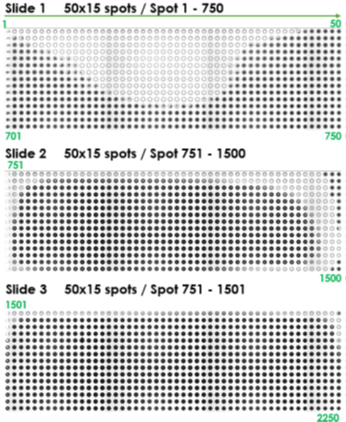
While the HA-containing solution could not be dispensed using sciDROP PICO technology, it was successfully handled with SCIENION’s sciDROP NANO technology, dispensing arrays of 50x 15 spots with 50 nl each on sciCHIP Epoxy slides (Figure 2):
All 2,250 spots were successfully printed with no missing spots.
Spots were accurately positioned, with no misalignment or merging observed.
Although partial drying during printing affected image contrast and measured spot diameters, print quality remained consistent.
Figure 2: Images of printed 50X 15 arrays of HA containing medium on 3 sciCHIP Epoxy slides taken with the Scan Spot Area software. *During this experiment, the spots partially dried out; different spot contrasts indicate the respective drying state of the spots in the array.
Overall, the results demonstrate that sciNANO technology can reproducibly dispense challenging sample types, such as highly viscous hyaluronic acid-containing media in the nanoliter range, providing reliable spot formation and precise patterning even for challenging liquids with non-Newtonian flow behaviour.
From Problem to Solution
Every reagent presents its own challenges, but with the right combination of dispensing technology, process expertise, and application-specific optimization, even demanding formulations can be handled reliably. Connect with our experts to assess feasibility, optimize your process, and unlock reliable dispensing performance for your most challenging reagents.