Läs våra de senaste nyheterna från våra affärsområden
2026-06-30
09:33
Breaking Barriers: Handling Challenging Surfaces with Microdispensing Technology
Share on facebook
Share on twitter
Share on linkedin
Many application scientists using microdispensing tools know the frustration: after investing in advanced dispensing technology and weeks of optimizing their protocols, they still experience unreproducible dispensing. The first assumption is that the instrument has reached its limits.
But many dispensing problems are not caused by the instrument itself. In this article, we examine surface-related causes behind “instrument issues” and explain how to resolve them to enable reliable and reproducible dispensing.
Understanding the Microdispensing Process
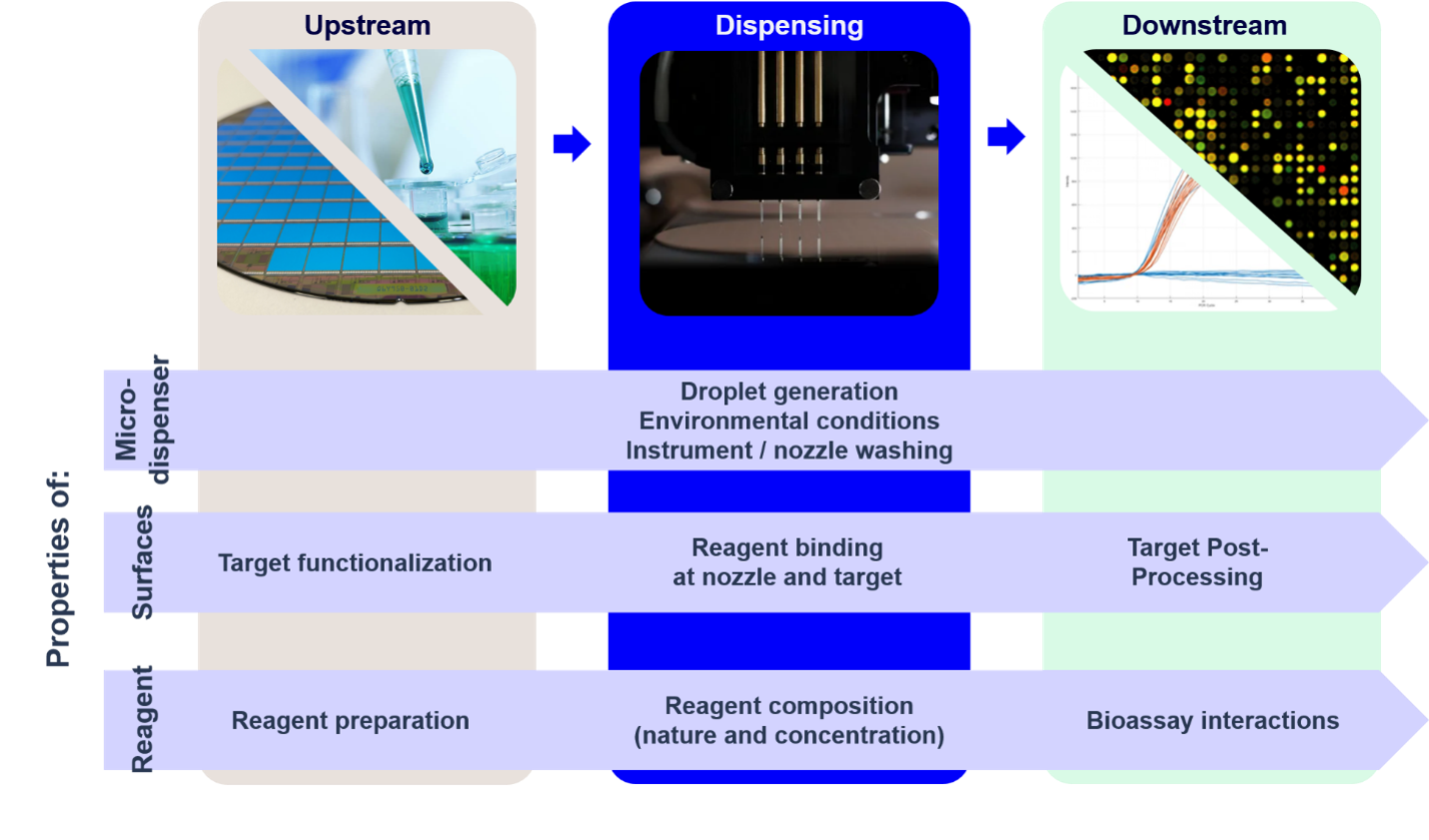
Before blaming the liquid handler, it’s important to understand key factors that can affect the dispensing process. The microdispensing process diagram below (Figure 1) highlights the factors that play a critical role in the accuracy, efficiency and robustness of microdispensing, either upstream, downstream or during the actual dispensing step.
These factors are linked to the microdispenser, the surface, or the dispensing reagent.
In this blog article, we specifically examine surface properties that are critical at every stage of the microdispensing workflow, from preparing the target for reagent binding, droplet ejection from the dispensing nozzle and binding onto the target surface, to downstream processing.
Figure 1: Key influencing factors in the microdispensing process
Three Surface-Related Opportunities to Improve Microdispensing Performance
Surface properties directly affect microdispensing success, from droplet behavior during dispensing to shaping the final spot after deposition and drying.
Note: A “droplet” refers to the tiny, controlled volume of liquid produced by the dispensing instrument, while a “spot” is the deposited feature that remains on the surface after drying.
Surface interactions directly govern three critical aspects:
Spot size and shape
Binding efficiency
Assay performance
Together, these factors ultimately determine assay reproducibility. The following three examples illustrate each of these aspects:
Example 1: Spot Size and Shape
Wettability is a critical factor controlling spot size and shape. It describes how easily a liquid spreads across or adheres to a surface and is determined by surface energy, chemistry, and roughness.
High surface energy makes the liquid spread more, resulting in flattened spots and larger spot sizes. Lower surface energy leads to a more spherical, smaller deposited spot. Wettability is typically measured by the contact angle, that is the angle formed between the droplet and the surface. A low contact angle (below 90°) indicates good wettability (hydrophilic), meaning the droplet spreads out. A high contact angle (above 90°) indicates poor wettability (hydrophobic), meaning the droplet beads up.
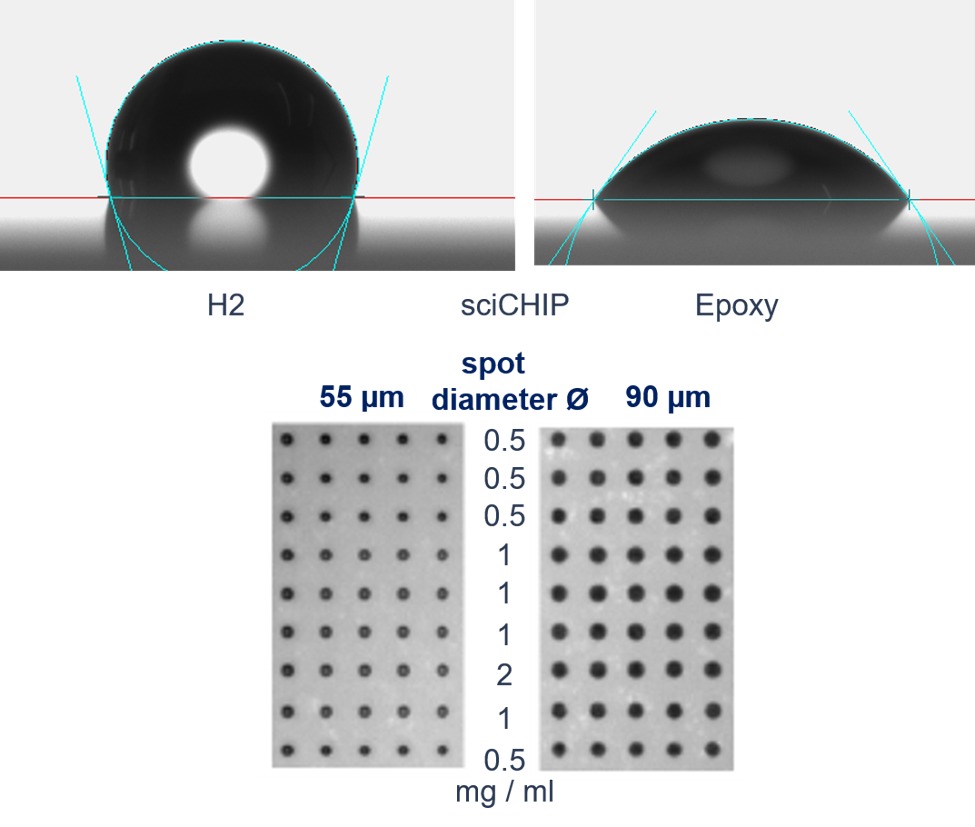
Figure 2 shows how different surface coatings affect wetting and spot formation. Droplets on an H₂ slide (low surface energy) remain compact and rounded, with higher contact angles. In contrast, droplets on an epoxy slide (high surface energy) spread more, forming larger, flatter spots with lower contact angles. Array images show spot diameters of approximately 55 µm on H₂ and about 90 µm on epoxy.
Figure 2: Top: Exemplary contact angle measurements of droplets illustrating wetting differences between H₂ and epoxy surfaces: greater spreading results in a lower contact angle and a larger spot diameter (right). Bottom: Head camera images of printed arrays (concentration series) on H₂ (left) and epoxy (right) sciCHIP slides show average spot diameters of 55 µm and 90 µm, respectively.
Example 2: Binding Efficiency
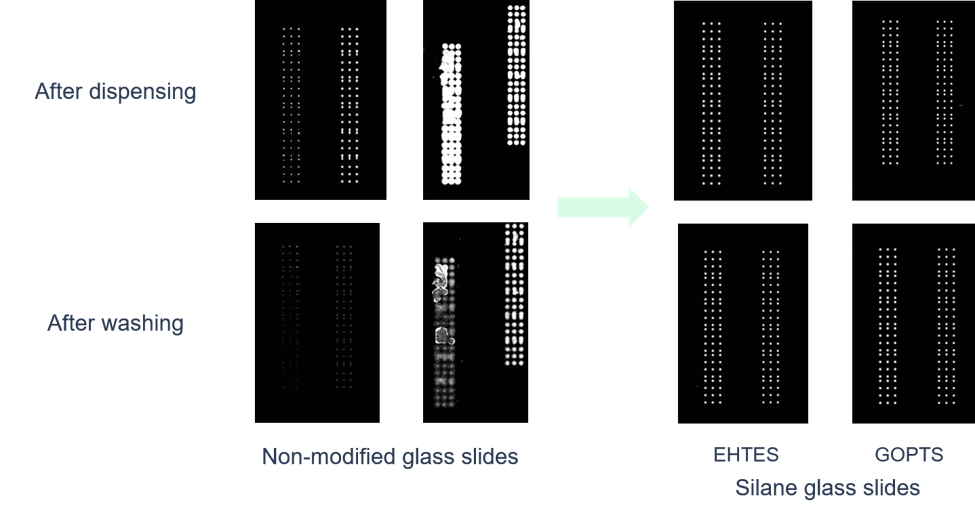
The example below (Figure 3) demonstrates how target surface chemistry directly affects reagent binding.
Non-modified glass slides from the same batch (top left) show a non-uniform distribution of dispensed spots, which become even more pronounced after a washing step (bottom left). When the target slides are functionalized, meaning coated with the right polymers – in this case 2 different silane polymers (EHTES and GOPTS), dispensed spots (top right) are (i) homogeneously distributed, (ii) uniform in size and morphology and (iii) stable, meaning not affected by additional washing steps (bottom right).
Consistent reagent distribution and stable binding are essential for reproducible assay results.
Figure 3: Effect of surface chemistry on spot quality and stability after dispensing and washing, comparing non-modified glass slides with silane-functionalized surfaces (EHTES, GOPTS).
Example 3: Spot Morphology and Assay Performance
The next example demonstrates how surface energy influences spot morphology and subsequent assay performance.
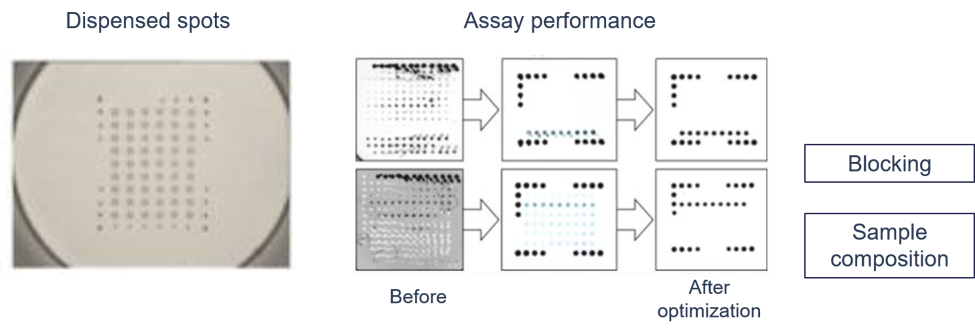
A microarray was printed into a well of a microtiter plate (Figure 4, left image), as captured by the head camera, revealing a uniform spot distribution.
However, when two different assay reagents were added (Figure 4, top and bottom panels), there were signs of non-specific binding and spreading of spots rather than a clean, circular profile. Such artifacts typically result from surface inhomogeneity or suboptimal reagent or buffer composition. These irregularities compromise signal uniformity and assay reproducibility.
After optimizing the protocol by adding a blocking solution (Figure 4, middle image) to cover unspecific binding sites and adjusting reagent composition, nonspecific binding was reduced and spot morphology became round and uniform (Figure 4, right image).
Figure 4: Buffer composition influences the morphology of printed spots and the assay readout. Left: Head camera image of dispensed spots. Middle/Right: Assay performance: Optimizing blocking and sample composition reduces non-specific binding and irregular/comet-like spots, improving assay performance.
From Problem to Solution
Surface properties play a key role in the success of microdispensing, influencing everything from droplet formation to final assay performance. Factors such as wettability determine how liquids spread, bind and dry on a substrate, directly affecting spot morphology, biomolecule binding and data reproducibility.
By understanding and optimizing these surface interactions—through careful selection of coatings, reagents and protocols researchers can achieve more consistent results in microarray printing and other microdispensing applications.
With 25 years of experience in liquid handling and surface chemistry, SCIENION addresses surface challenges by offering customized engineered Piezo Dispense Capillaries (PDC) and Nano Dispense Capillaries (NDC) with surface coatings to handle aqueous buffers, organic solvents, or complex protein mixtures.
Moreover, SCIENION offers surface-treated plates and chips to match the needs for diverse microdispensing applications with optimized coatings: sciPLATES and CHIPS – SCIENION.
Consulting with our expert application scientists can help you identify the best materials and coatings for your specific reagents and workflow. SCIENION supports customers through contract development to evaluate, develop and scale surface modifications, with expertise across the entire workflow from surface preparation to dispensing and assay performance.
Ready to Push the Limits?
Connect with our experts to explore feasibility and unlock reliable dispensing for even your most challenging reagents